
Luke 18:9 “To some who were confident of their own righteousness and looked down on everyone else, Jesus told this parable:”

Whenever the subject of self-righteousness comes up, Pharisees have always been the easy target of ridicule and scorn.
It’s so easy to look at a pharisaical model and see self-righteousness, the men who were so full of themselves they missed the Messiah, and yet we too can forget how easy it is to fall into the same trap of exalting mankind.
Morally superiority is not a condition that is exclusive to spiritually inclined people, just about everyone I know, (including myself), has or has had an inflated view of their own position. The idea that my views or lifestyle is somehow superior to another can make me feel like I have taken the high road of life and can thereby be critical of another.
Political activists think their candidate and political platform is justifiably greater than the opposing platform. The two parties condemn the other candidate by attacking their past actions, voting record, or a public image they may have displayed in their past. Politics can be so divisive.
When I was a kid, it wasn’t uncommon to think of my own church denomination as being morally superior over other denominations, this has been a common practice among certain people groups even today. If a church practices in such a way that violates the Word of God, they have deviated from the Truth of God. The illusion that every practice is equal and continues with a same purpose is the false representation of Universalist churches worldwide.
Feelings of moral superiority extend into nearly every area of life, from raising children, eating habits, recreation, t.v. viewing habits, books we read, the way we speak, and even our level of education can be areas that we exalt ourselves in and feel superior to another.
Can you find any place in God’s Word that encourages a heart of moral superiority? Before answering that, consider the destructive nature of placing man in a position of undo relevance. History has shown how devastating these actions are in society.
The Pharisee and the Tax Collector
Luke 18:10-14 “Two men went up to the temple to pray, one a Pharisee and the other a tax collector. The Pharisee stood and prayed thus with himself, ‘God, I thank You that I am not like other men—extortioners, unjust, adulterers, or even as this tax collector. I fast twice a week; I give tithes of all that I possess.’ And the tax collector, standing afar off, would not so much as raise his eyes to heaven, but beat his breast, saying, ‘God, be merciful to me a sinner!’ I tell you, this man went down to his house justified rather than the other; for everyone who exalts himself will be humbled, and he who humbles himself will be exalted.”
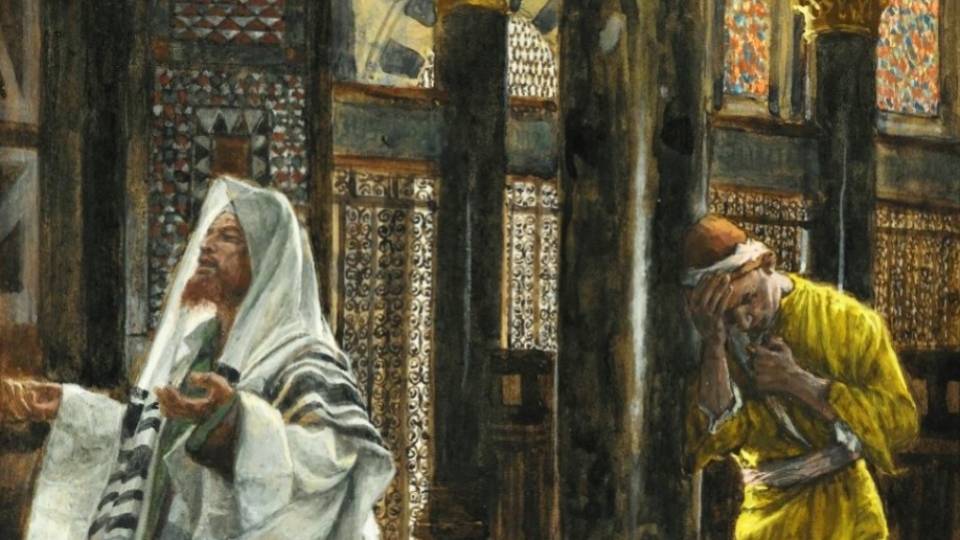
The comparison Jesus used between one who was spiritually edified and one who was financially edified is an interesting contrast. The Pharisee held a position of religious power that often exerted itself in condemnation of anyone who even appeared to be violating God’s laws. The tax collector was considered a traitor to the jewish nation, the act of being a pawn for the Roman government to exact heavy taxes on the people was considered one of the lowest positions among the people.
The pharisee in his religious zeal considered himself a favorite of God’s anointed. Surely God must favor me if I have set myself apart for His purposes and lived (mostly) perfect according to the law, they might say.
Religious zeal was very dangerous back then and this trend has proven so throughout history. Some of the most atrocious acts recorded against people groups have been done in the name of religion.
The tax collector knew he was a traitor to his people. Money was his god and the temptation to exhort a little more for oneself was probably too difficult to overcome. The conviction of dishonoring God by stealing from His people was one that we find brought repentance in the heart of the tax collector and subsequent condemnation from the one who thought ge had lived a righteous life.
A key factor that distinguishes one man from another is the heart of humility.
It’s one thing to know your a sinner and respond with remorse, it’s quite another to think you stand justified when your just as guilty as the other. This pharisaical attitude diminishes others in the minds of those who think they are above reproach with a greater severity than if they hadn’t been religious at all.
True Justification
Justification according to Jesus comes solely from God. It is the act of being declared or made righteous in the sight of God which brings people into a right standing before Him.

Galatians 2:16 “yet we know that a person is not justified by works of the law but through faith in Jesus Christ, so we also have believed in Christ Jesus, in order to be justified by faith in Christ and not by works of the law, because by works of the law no one will be justified.”
The tax collector couldn’t be fully justified by the simple recognition of his sin, he had to rely on the Mercy of God to complete the process.
A criminal doesn’t find grace from the crime simply by recognizing he erred in judgement, he has to receive mercy from the judge before being fully exonerated of his crimes.
Jesus fulfilled the requirements of the law which required death. We all have sinned thus we all deserve the consequences of our actions. It is when we recognize the full weight of the law in regards to our condition that we are brought low before God….it is then that He says He will lift us up.
Isaiah 57:15 “For thus says the One who is high and lifted up, who inhabits eternity, whose name is Holy: “I dwell in the high and holy place, and also with him who is of a contrite and lowly spirit, to revive the spirit of the lowly, and to revive the heart of the contrite.”
Brokenhearted people display remorse from a spirit that recognizes moral depravity, not moral superiority.
Morally superior people have to compare themselves to a standard that exalts their position and comparing themselves to other people are the only ways they can do this.
How do we know if we are higher morally than another?
Self-Reflection
By what measure can we compare ourselves to other people?
Is it the ways someone talks?–maybe they use occasional profanity and don’t even realize it because they used it so much as a non-believer it is a habit that hasn’t brought the fullness of conviction yet.
Could someones daily habits bring about a sense of condemnation?—You may be going to church on Sunday mornings, nights, and even Wednesday’s, while your neighbor only shows up on Sunday mornings and looks a little unkempt at that! The sense that a higher frequency of attending church somehow elevates a person in God’s eyes is a common trend I witnessed often as a young man.
Maybe you know someone who doesn’t read as much as you do, or have the same level of biblical knowledge, or could it be that their kids seem a little unruly and so you judge their parenting skills as a means to justify yourself?

We have so many ways we compare ourselves, it is a trend that affects every walk of life. I remember going to Tijuana in the early 1990’s and the missionary was sharing with us a group of people who lived on a nearby hill. The muddy looking homeless encampment had many tiers of shanty houses, and the houses had various types of roofs. Some homes had corrugated metal, others had sticks, and some had mud and straw. The missionary said the metal roofed people looked down on the stick roof people. The stick roofed people looked down on the straw roofed people and consequently the height of each home brought another form of superiority. The people who lived on this hill were the poorest of the poor and yet they found a way to look down upon one another.
Philippians 2:1-4 “Therefore if there is any consolation in Christ, if any comfort of love, if any fellowship of the Spirit, if any affection and mercy, fulfill my joy by being like-minded, having the same love, being of one accord, of one mind. Let nothing be done through selfish ambition or conceit, but in lowliness of mind let each esteem others better than himself. Let each of you look out not only for his own interests, but also for the interests of others.”
The only way to break out of a trend of moral superiority is by learning to love others better. When we see others as we see ourselves, particularly in the unity of the faith, we can be of one accord by knowing and seeing the value God sees in others. The pattern of loving others is one that was established first by Jesus and is the standard we can hold ourselves to in regards to how we live our lives.
Philippians 2:5-8 “Let this mind be in you which was also in Christ Jesus, who, being in the form of God, did not consider it robbery to be equal with God, but made Himself of no reputation, taking the form of a bondservant, and coming in the likeness of men. And being found in appearance as a man, He humbled Himself and became obedient to the point of death, even the death of the cross.”
The way we move forward in righteousness is by changing our mindset. When we draw near to Christ in humility, we can see ourselves in light of His Holiness and our little petty self-justification suddenly becomes diminished in perspective to the magnitude of His glory.

When we witness the humility of the King of kings, our moral superiority is placed within the benchmark of Christ’s perfection—the realization that we are nothing before God becomes much more apparent.
Confession and Repentance
If upon examining our hearts and minds we find that we have placed ourselves into a position that was not granted by God, the only way out is to bring that sin before the Father. He is the One we have ultimately offended, it was His people we have dishonored and shown hatred toward in pride. We must confess our sins and repent of our ways, that we might be healed.
The good news is the Lord is quick to forgive, His grace has no bounds, and His love endures forever. He will restore the sinner and in humility He will lift them up higher than they could have ever done on their own.
You see, the humble in God’s Kingdom have the greater honor.
Every gift given, every selfless act of love has great value in the Kingdom of God and when exhibited among God’s people, He is glorified….. and that alone is enough.

 U.T.
U.T. 
“yet we know that a person is not justified by works of the law but through faith in Jesus Christ, so we also have believed in Christ Jesus, in order to be justified by faith in Christ and not by works of the law, because by works of the law no one will be justified.”.. the Law of God is not the law of man that no one will be justified by the works of the law. belief and faith in Christ Jesus is obedience to the Law of God where lies justification.
LikeLike
Amen brother.
LikeLike